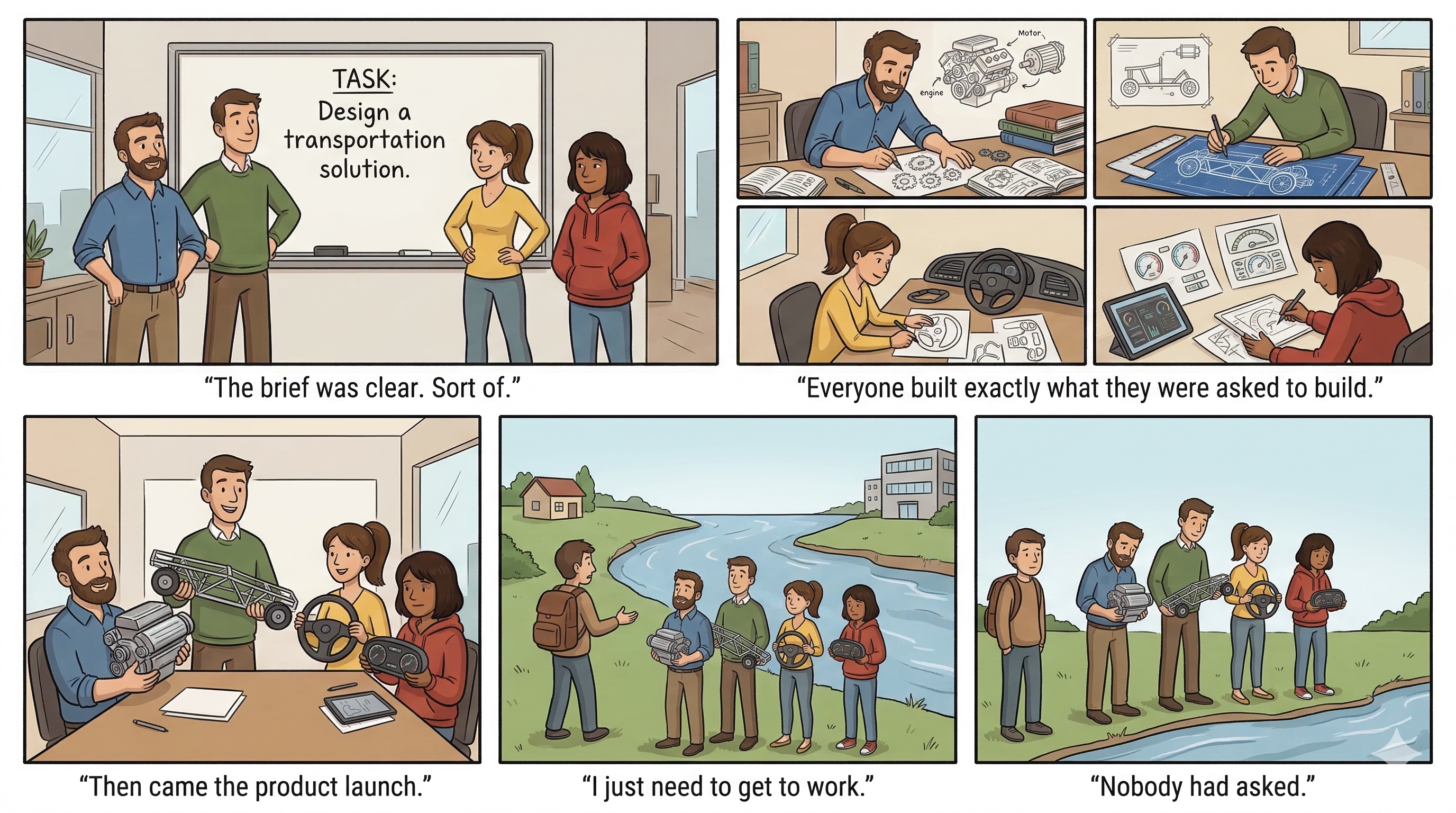
The brief was clear. Sort of.
The comic above is funny because you recognize it immediately. You’re probably laughing because you’ve seen it. Maybe you’ve been one of the four.
Here’s what makes this pattern so persistent: nobody in the story is doing anything wrong. The motor person built a good motor. The frame person built a good frame. Everyone showed up, did their job, and delivered exactly what they were asked for. Competence is not the problem.
The problem is that the question was never asked.
Not “what are we building?” — that question gets answered constantly, in roadmaps and planning sessions and sprint reviews. The question that doesn’t get asked is simpler and harder: what does this person actually need to do?
“The question that doesn’t get asked is simpler and harder: what does this person actually need to do?”
I’m watching a version of this play out right now. Multiple workstreams, each enabling real functionality, each making progress. The work is legitimate. The people are capable. And the gap between what’s being built and what a user will actually experience on the other side of it is growing quietly, unexamined — because the workstreams aren’t converging around a user path. They’re converging around a delivery date.
Nobody has stood at the river yet.
The prior question isn’t how do we work together. It’s what does this person need to do, and where does it break down for them.
The instinct when you recognize this pattern is to call for more collaboration — more meetings, more cross-functional alignment, more touchpoints between the workstreams. That’s not wrong, but it’s not the root fix. Teams can coordinate perfectly and still build the wrong thing together.
Coordination without a shared picture of the user need just means the four teams meet more often while still holding incompatible parts. Answer the user question first, and the coordination question largely answers itself — because now everyone can see the seam from the user’s side.
Everything else flows from that or it doesn’t flow at all.